Showing posts with label organic turf. Show all posts

Monday, October 31, 2016

Q&A with Chip Osborne, President of Osborne Organics, Inc.


1.    Please describe your business in 50 words or less.
Osborne Organics consults with local, state, and federal agencies as well as universities and other institutional clients to transition landscapes to natural, organic practices and protocols with a specialty in natural turf. Osborne Organics has developed the “Systems Approach to Natural Turf Management” and offers professional training around the country.

2.    What is the state of the organic gardening industry? Where do you see the greatest growth and what’s driving it?  I believe the organic gardening, landscape, and turf industries are strong and continually growing. We are currently experiencing a tipping point, or change in the marketplace, that we have pointed to for the past twenty years. Organic practices are no longer on the fringe, but are now mainstream.
 
Chip Osborne
The concept of the organic landscape began with the homeowner (residential property) some time ago. It is now widely being considered as the management protocol of choice for larger properties, both commercial and private. When that segment is combined with a strong interest by the municipal sector for organic practices, products, and protocols for playing fields and public spaces where children play, we can now point towards some significant numbers.

This is being driven by the public’s perception regarding the dangers of pesticides. We are seeing the results of tireless efforts by many advocates over the years who have worked at the grassroots level to change people’s minds regarding the use of synthetic water soluble fertilizers and chemical pesticides.
It is the change in the marketplace that continues to move all of this forward. In addition to that, legislation is now being enacted around a variety issues at the state, county, and local level regarding restrictions of different types on pesticides and synthetic fertilizer use.

There is growing interest across all segments of society regarding organic practices. They include residential properties that range from small homes to large estates, commercial properties, hotels, resorts, colleges, universities, and golf courses. The main theme across them all is the desire to have a healthier environment for work and play.


There is a geographical component to the acceptance of organic practices. There is no question that Massachusetts, Connecticut, and Westchester County in NY are the birthplaces of organic land care. We are excited to see the growing interest in New Jersey, the mid- Atlantic, particularly Maryland, the upper Midwest, the Pacific Northwest, and Southern California. Accredited Organic Land Care Professionals (AOLCPs) can be proud knowing that they are part of an organization that worked from the beginning with others to lay the groundwork to effect tremendous change.


3.    What are some of the most common challenges professionals face in caring for the land organically and what approach do you take to solving them

From my perspective, the problems are not product oriented entirely. There are limitations in materials that we can use, but for the most part most resources are available to us. The organic product industry has evolved to a point where we now have access to state-of-the-art fertility and soil health inputs that focus on the biomass more than the plant. Knowing that a natural system in many cases can manage itself, the product becomes somewhat secondary.

We now have a variety of organic insecticides and fungicides should we need to intervene. For those that manage turf grass and hardscape, a limiting factor can be minimal, cost-effective product to address weeds.

Developing a tolerance, or weed threshold, is critically important in all aspects of the managed landscape. We need to move beyond the concept of a monoculture. That being said, all organic landscape professionals at some point in time are faced with managing a misplaced plant effectively for a client. It can be a challenge, but is getting easier as new materials are developed.

The greatest challenge in my mind is the comfort of organic professionals to communicate to others what we believe in and do. Many of us have adopted these practices to reduce the use of pesticides, others to reduce synthetic runoff, and others because they have always done it that way. Some of us came from the conventional industry and have adopted organic management practices as a result of what we experienced firsthand.

The driving factor for me is the reduction and elimination of pesticide use in the landscape. Contrary to information put forth by the conventional product industry, landscapes do not get better with the use of synthetic materials. I know firsthand that movement towards an organic approach immediately improves the landscape. There is absolutely no question that the organic landscape looks, performs, and pleases to a far greater degree than its chemical counterpart.

4.    What advice do you have for conventional land care professionals who are considering transitioning to organic?

Forward thinking conventional practitioners are beginning to seek out opportunities to understand and learn about organic lawn and land care. It does take the change in market demand to bring many of them to the table. They may not approach organic from the same perspective that we do. It might be, and probably is, more rooted in financial interests, but whatever it takes is fine with me. I firmly believe that the more widespread adoption of organic lawn and land care practices and protocols on a national level is simply limited by the lack of education about how it needs to be approached.

CT NOFA's Organic Land Care Program has responded to the challenge for the past fifteen years to meet that demand. When I interact with the conventional industry, I make them aware that there is a learning curve and that it is to their best interest to seek out education. Because what we do is not just putting down product, those that try the product swap-out will usually fail. In addition to the initial learning experience, keeping abreast of changes with continuing education is, and will be, critically important for all of us.

5.    How do you consider your business to be part of the solution to environmental degradation and overuse of synthetic fertilizers and pesticides? How do you educate your clientele?

Osborne Organics works with a diverse group of clients that range from individual landscape professionals to the federal government and everything in between. We would like to think that in some small way we can influence the market by showing that the debate about the safety and dangers of pesticides is now less relevant because we have proven that alternative non-chemical strategies can work and meet expectations. With strategies that work on one hand and the precautionary principle on the other, it is difficult not to embrace alternatives.

Friday, September 30, 2016

63 attendees at the Organic Turf and Athletic Fields Workshop on September 22nd!

Full room at Cheshire Park and Rec!
Written by Jenna Messier, NOFA OLC Program Director

We had a great turnout last week at our first NOFA Advanced Workshop on Organic Turf and Athletic Fields, held in Cheshire, CT at the Parks and Recreation Department.  Over half of the attendees were municipal employees who actively manage town parks, properties and athletic fields, and the others were Accredited Organic Land Care Professionals who are looking to learn more about new developments in organic fertility and lawn care.

Chuck Sherwood
Chuck Sherwood, owner of Sherwood Sportsturf and contractor with Cheshire Park and Rec. Department, started out the day by explaining his approach and practices which he has been delivering on Cheshire's many sports fields.  Chuck has been utilizing soil tests and focusing on improving the Calcium to Magnesium ratio in order for nutrients to be available for the turfgrass. Chuck has worked for many towns in Connecticut and he shared with the audience the necessity for working within a town's budget to create each individual field's management plan.  Thankfully, Cheshire has irrigation and enough fields to allow some fields to be rested, in order to renovate the turf with aeration and seed.  The fields which we visited for the on-site demonstration were not being played on until late Spring or early Summer, which is why we chose the site for added inputs.

Chip Osborne
Chip Osborne from Osborne Organics, a national consulting service, spoke about his practices of reviewing chemical soil tests and additionally soil bioassays, in order to survey the state of the soil prior to making any land care decisions.  Chip consults for the National Parks Department and has also volunteered for many years in his hometown of Marblehead, Massachusetts as the advisor for all town parks and sports fields which have been organic for over 10 years.

Chip reviewed both of the soil tests from the Far Fields at Bartram Park, and he noted that the pH was lower than desired and the soil was fungal-dominated; which is not the best scenario for turf which prefers bacterial-dominated soils for optimum nutrient cycling.  The soil bioassay was provided by Soil FoodWeb NY, and was very helpful when Compostwerks planned their brewing of compost tea for the afternoon application.

After the soil test review, Chip discussed some of the parameters for a municipality to plan for organic turf management.  He also stressed the reality of working within town budgets and taking a longer-term approach to improving soil health, such as selecting priority fields to put resources into, and choosing to re-seed one year, perhaps fertilize the next year, and select aeration in year three, as examples of spreading practices over time. Chip shared his view of what turf management has evolved to, including the following innovations:
  1. Creating programs which address short and long term needs of the turf, while addressing soil health
  2. The combination of liquid and granular applications as a strategy
  3. The improvement of liquid fertilizers now available on the market in powder and liquid forms
  4. The very strong emphasis on providing food and resources to foster healthy microbial life within a turf program.
Frank Crandall
Next, we were joined by Frank Crandall from Frank Crandall Horticultural Solutions, a Rhode Island-based company which provides business consulting and workshops. He first reviewed some accounting practices for assessing the cost of equipment. Then he moved on to incorporate methods for pricing particular organic practices which were suggested by Chip, such as pricing for granular and liquid applications, over-seeding, and providing microbial foods such as humates or molasses.  Frank gave us his spreadsheets electronically, which can be found at the bottom of the webpage for the workshop at http://organiclandcare.net/education/advanced-workshops


Jenna and Jeff
Before lunch break, CT NOFA's Executive Director, Jeff Cordulack, thanked all of our presenters with his signature token of thanks - a jar of honey - symbolic of the importance of caring for pollinators with sound land care practices.  Jeff also surprised me, the author Jenna Messier, with an acknowledgement of my 5 years of work at CT NOFA, reading a letter from our Board of Directors and giving me a bonus in the form of a check.  Very nice, yet I couldn't stop blushing. It was truly an honor.

Bad lighting, but glad to have a picture of so many intelligent land care professionals together!
Tom Corradino
After lunch we headed out to the Far Fields at Bartram Park, where field hockey will be played next year.  We started with the aeration demonstration, in which Tom Corradino, from Schmidts and Serafines, a hardware store and power equipment shop located in Waterbury, gave us some information about the equipment while co-owner Lee Schmidt did the aerating by riding up and down the field. You can either rent a machine or purchase depending upon your expected usage. The process of core aeration involves soil cores being removed from the turf so that oxygen can enter into the root zone and relieving compaction.


Soil cores will disintegrate in time

Left to right, Peter, Lee and B.G.


Peter Schmidt and Gregg Twehues


Next, Peter Schmidt from Compostwerks, talked about the process of brewing compost tea, which is utilized as a fertilizer and a source of microbial biological life forms that are critical for nutrient cycling in the soil.  Very early in the morning, the tea needed to be brewed prior to the workshop, due to its short life span of 6 hours.

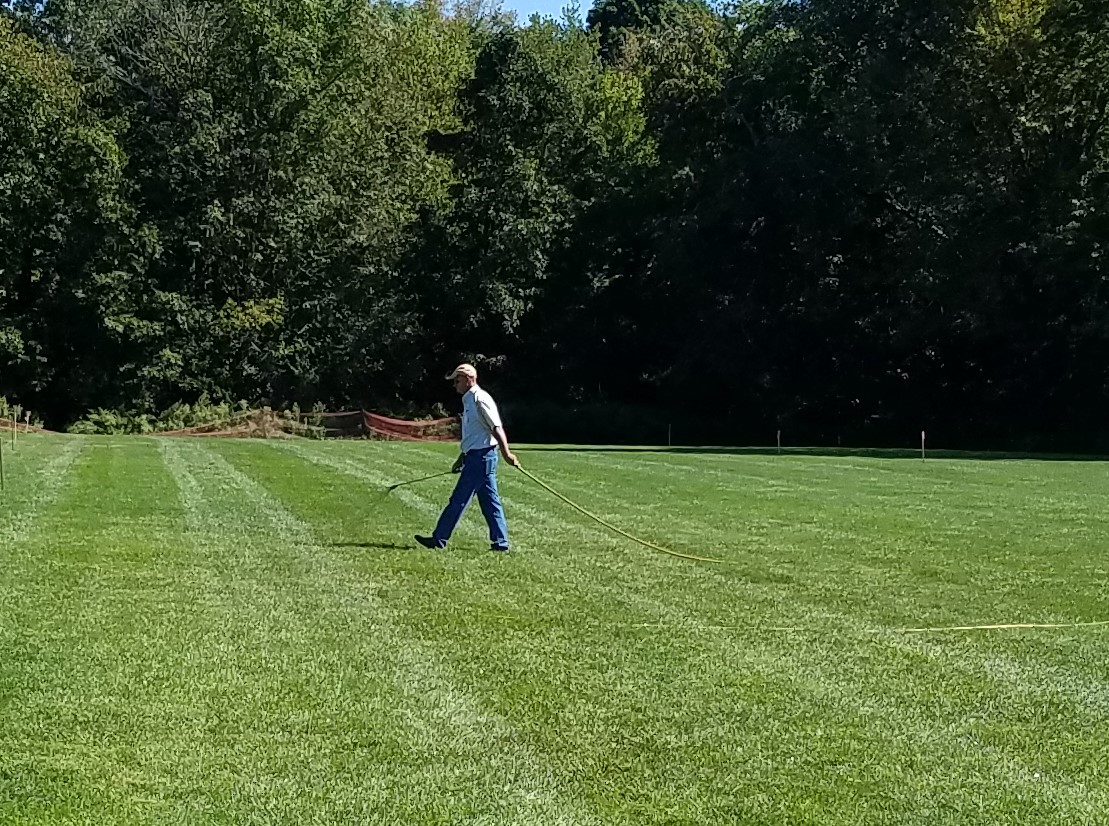
The tea is kept in a tank with aeration in order to keep the biology alive and oxygenated until the application. They have 3 tanks on their truck which allows for different blends to be brought to a property.  Some plants require a fungal-dominated biology and some require more bacteria to thrive, so each brewing is a unique and calculated blend. Additional amendments were displayed, such as molasses, which they added to the tea right before applying to provide food for the biology to thrive. Gregg Twehues, co-owner of Compostwerks, demonstrated the application process as he walked back and forth across the fields with the wand and hose, spraying the compost tea evenly.

Gregg is applying the compost tea, which smelled very sweet due to the molasses
The afternoon was planned to allow distributors of organic fertility products to explain to the audience specifically how their products work. NOFA OLC does not recommend one particular product or company over another, however, we see this as part of our mission. The NOFA Standards for Organic Land Care do not allow for synthetic fertilizers or pesticides. Thus, land care professionals have a critical need to learn about how organic fertilizers are different from the traditional fertilizers, where to find the products, and to know there is a big selection for different budgets and situations.

Fred Newcombe from PJC
After the outdoor demo, we returned to the classroom to discuss organic fertility products with some of the most knowledgeable folks in the business!  Fred Newcombe from PJC Organics talked about their granular fertilizers, namely the Renaissance brand, which his company manufactures. They specialize in serving the municipal market with wholesale pricing and by offering expert advice to their clients.
Joe Magazzi, Green Earth Ag&Turf

Next, we had Joe Magazzi from Green Earth Ag & Turf speak about
how organic fertility products have come a long way in their development, how the price points have come down, and he described how they work differently than synthetic fertilizers. He distributes a product called Quantum Growth which is very popular these days, being used on professional sports fields around the country.  His company also offers organic and biological pest control products as well.
Peter Schmidt

Peter Schmidt discussed the process of brewing compost tea in greater depth than in the outdoor demonstration. In addition, he shared with the group when to select compost or compost tea as the application of choice. Compost is great for adding organic matter, but you should not apply more than a 1/4 inch topdress per application, with concern over adding too much phosphorus in the soil and getting into our waterways.  However, compost tea adds the biology alone and there is not a concern for adding too much.

Our speaker from Hart's Seeds was not feeling well, and unfortunately we missed his presentation. However, we should mention that Hart's Seeds is a Connecticut based seed company which offers many blends of grass seed in bulk shipments. We hope to have Paul back another time!

Chip Osborne and Frank Crandall provided a wrap-up for the day, reminding students that an organic program can be achieved at a variety of prices, and is in direct relation to the level of expectations which the land manager is being held to. A high level of expectation will require a high level of inputs, cultural practices, and over-seeding and will thus require a higher level of spending. This is a conversation which must be had between a municipal employee or a contractor and the decision makers involved.  Frank then told the group to provide the best budgets and estimates possible in order to communicate in financial numbers to town managers all costs involved.

It was a great day, thanks to all for coming!


Thursday, June 30, 2016

Inside the Organic Land Care Industry: An Interview with PJC Organic


A Q&A with Pam Newcombe of PJC Organic and Renaissance All Natural Fertilizers, sponsors of the NOFA OLC Organic Land Care Accreditation Course being held in Maine this August.

Pam and Fred Newcombe began PJC Organic as a full service landscape provider specializing in organic fertilization services and in 2006 purchased Renaissance All Natural Fertilizers. Today the company provides product, support and business tools to landscapers, municipalities and schools that want to develop an organic turf care program that fits their business. They also offer organic fertilization services on Boston's North Shore, giving them the opportunity to continually evaluate the products they manufacture and distribute. 


Fred Newcombe of PJC Organic
Q: What is the state of the organic land care industry? Where do you see the greatest growth and what’s driving it? 

The organic land care industry, as it relates to turf, is growing at a faster rate than the conventional market based on feedback from our customers. We’ve found the greatest areas of interest are in states that have implemented pesticide and fertilizer use restrictions. Because there is often a time of transition between passage of laws and required implementation, this change is often seen 2+ years after legislation is in place. The East coast seems to be a leader in this arena. I think the private sector is growing quicker than municipal because of budget issues with towns. 


Q: What are some of the most common challenges professionals face in caring for the land organically and what approach to you take to solving them?
 
The biggest challenge in the Northeast is that grass is not native, so there is a time of transition required to bring the soil to the place where grass wants to grow, and people can be impatient. Current soil conditions, turf density and budget will determine how long the transition will take. 

By far the most common questions are – what are you going to do about weeds and grubs? Our standard reply is weeds as an indication of underlying soil conditions. If you simply kill a weed it doesn’t mean grass will grow. 

We try to keep our approach simple by working in 4 areas:
1) Soil chemistry: meet NPK needs and adjust pH
2) Soil Structure: promote porosity & nutrient holding capacity of the soil by improving OM & CEC
3) Soil Biology: feed the microbes so they can feed the plan. When #1 & 2 are addressed, desirable biology will come out of dormancy. On really bad lawns it may be necessary to apply compost, pelleted compost or compost tea 
4) Cultural practices by far is the most important of the 4 steps - proper mowing, watering, over seeding, etc. By focusing on these 4 areas you can create a dense stand of turf that will outcompete weeds. 

The other challenge for both the professional and homeowner is choosing products. Because this is an emerging industry, the government hasn’t begun to regulate the term “organic” in labeling turf and ag products. Unlike like the food industry, turf products are not “certified” organic by the USDA. There are many products that claim to be “organic” but are not All Natural, which can be misleading.

We have chosen to get our Renaissance 8-1-6 OMRI listed. Which means the Organic Materials Review Institute (OMRI), an independent agency, has determined our fertilizer meets the National Organic Program (NOP) standards. Because all our Renaissance formulations are a derivative of our OMRI listed 8-1-6, our Renaissance blends meet the NOP standards. Companies that say their products comply with NOP standards without going through a recognized approval agency are self-certifying and there is no one policing that market right now. Second, we have intentionally kept our Organic Fertilization Service business as a way to test new products coming on the market so we can speak from personal experience when reselling them, and also consider how the products we sell work together. 

Q: What advice do you have for conventional land care professionals who are considering transitioning to organic?
 
I would say the homeowner demand is growing and eventually legislation will necessitate the change, so be an early adopter and position yourself as a leader in that market. That being said, simply swapping a bag of organic fertilizer for a bag of synthetic fertilizer won’t work. Learning how to take and interpret a soil test is key in determining products and putting together a program. You don’t need to buy expensive equipment - you can have a successful program using granular only and a broadcast spreader, or if you already have the ability to do liquids a granular liquid combination can work as well. Get trained and network. Because there’s no “4 step program” it’s common for us to hear from potential customers that they just finished training and don’t know where to start. This is where we can help, as well as networking organic professionals with one another. Also, don’t fall for the latest products on the market because they might not be there next year. Put together a program that addresses underlying soil conditions and stay the course. 

Q: How has your AOLCP (Accredited Organic Land Care Professional) training and accreditation helped your business?
 
Fred Newcombe has been an AOLCP since 2005 which has set us apart in the service industry from those just jumping on the wagon. It is also helpful to have the OLC standards to refer to when deciding what things are allowed as a rescue treatment, how often you recommend soil testing, etc. Also being on the NOFA Organic Land Care Approved product list has helped set us apart as a product provider. 


Pam Newcombe of PJC Organic can be reached at pam@organicfertilizer.com, 978-432-1019, or pjcorganic.com.